Welcome to Our Website

1
2
3
4
5
6
7
8
9
10
11
12

Armenia officially the Republic of Armenia,is a landlocked country in the Armenian Highlands of West Asia.[15][16] It is a part of the Caucasus region and is bordered by Turkey to the west, Georgia to the north and Azerbaijan to the east, and Iran and the Azerbaijani exclave of Nakhchivan to the south.[17] Yerevan is the capital, largest city and financial center. Armenia is a unitary, multi-party, democratic nation-state with an ancient cultural heritage. The first Armenian state of Urartu was established in 860 BC, and by the 6th century BC it was replaced by the Satrapy of Armenia. The Kingdom of Armenia reached its height under Tigranes the Great in the 1st century BC and in the year 301 became the first state in the world to adopt Christianity as its official religion.[18][19][20][c] Armenia still recognises the Armenian Apostolic Church, the world's oldest national church, as the country's primary religious establishment.[21][d] The ancient Armenian kingdom was split between the Byzantine and Sasanian Empires around the early 5th century. Under the Bagratuni dynasty, the Bagratid Kingdom of Armenia was restored in the 9th century before falling in 1045. Cilician Armenia, an Armenian principality and later a kingdom, was located on the coast of the Mediterranean Sea between the 11th and 14th centuries.
Nature Image

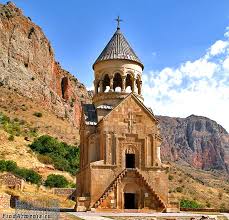
Noravank

Noravank (Armenian: Նորավանք, lit. 'new monastery') is a 13th-century Armenian monastery, located 122 km from Yerevan in a narrow gorge made by the Amaghu River, near the town of Yeghegnadzor in Armenia. The gorge is known for its tall, sheer, brick-red cliffs, directly across from the monastery. The monastery is best known for its two-storey Surb Astvatsatsin (Holy Mother of God) Church, which grants access to the second floor by way of a narrow stone-made staircase jutting out from the face of building. The monastery is sometimes called Noravank at Amaghu, with Amaghu being the name of a small and nowadays abandoned village above the canyon, in order to distinguish it from Bgheno-Noravank, near Goris. In the 13th–14th centuries the monastery became a residence of Syunik's bishops and, consequently, a major religious and, later, cultural center of Armenia closely connected with many of the local seats of learning, especially with Gladzor's famed university and library.

Noravanks history

Noravank was founded in 1105 by Bishop Hovhannes, a former abbot of Vahanavank near the present-day city of Kapan in Syunik. The monastic complex includes the church of S. Karapet, S. Grigor chapel with a vaulted hall, and the church of S. Astvatsatsin (Holy Mother of God). Ruins of various civil buildings and khachkars are found both inside and outside of the compound walls. Noravank was the residence of the Orbelian princes. The architect Siranes and the miniature painter and sculptor Momik worked here in the latter part of the thirteenth and early fourteenth century.[1]

Contact Us

The Information was helpful